

As engineers grow, the biggest shift is not learning new syntax, but learning to recognize bad code early. These mistakes have names for a reason, they show up everywhere, across teams, languages, and seniority levels.
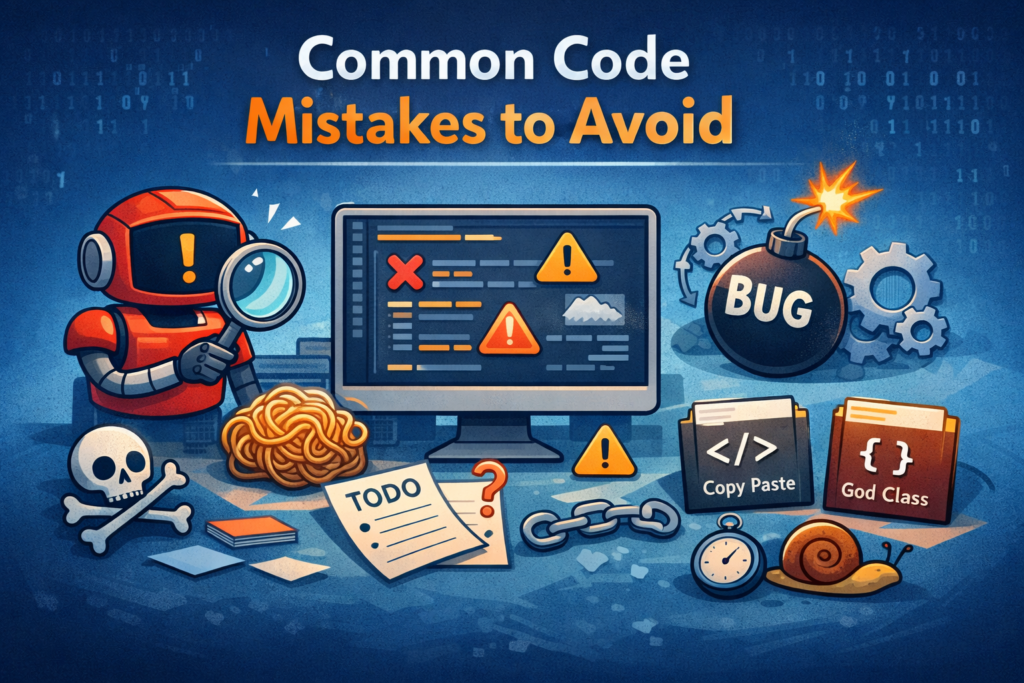
This post is a practical breakdown of common code mistakes, why they happen, and why seniors care so much about them.
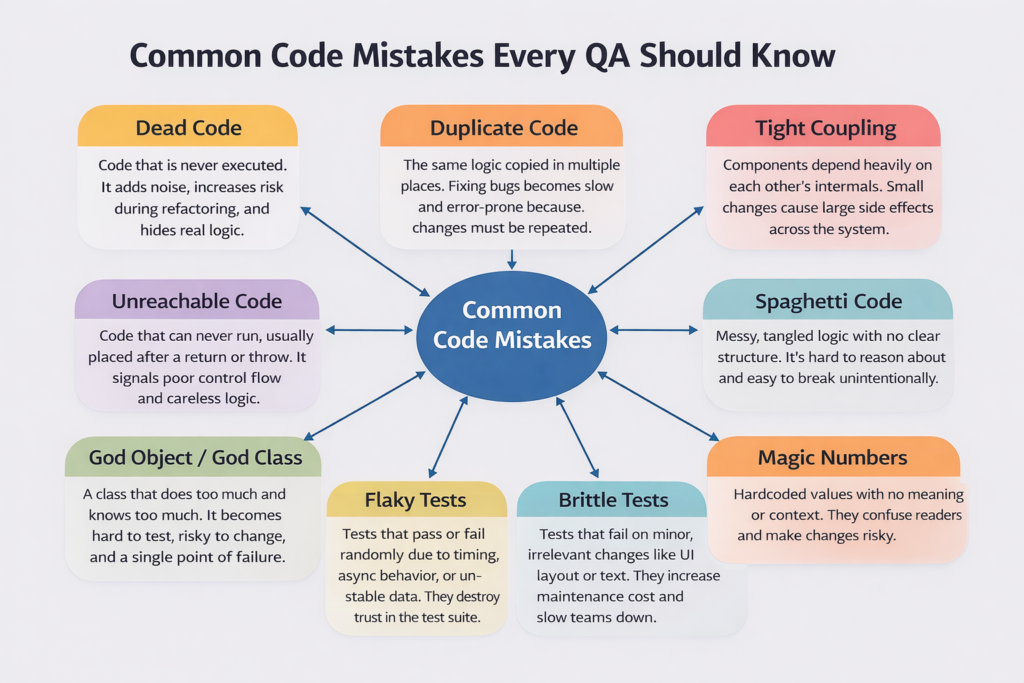
1. Dead Code
What it is
Code that never runs or is no longer used.
‘If this condition is never true, why is it still here?’
Why it’s bad
- Adds noise and confusion
- Makes refactoring risky
- Hides real logic
Why it happens
Old features, rushed fixes, fear of deleting things.
2. Unreachable Code
What it is
Code that can never be executed, for example after a return or throw.
Why it’s bad
- Signals poor control flow
- Misleads future readers
This is often caught by linters, but still common in messy codebases.
3. Duplicate Code
What it is
The same logic copied across multiple places.
Why it’s bad
- One change requires many edits
- Bugs multiply fast
Classic symptom
You fix one bug, three more appear elsewhere.
4. God Class / God Object
What it is
One class that knows everything and does everything.
Why it’s bad
- Impossible to test properly
- Hard to change safely
- Becomes a bottleneck
If you’re afraid to touch a file, it’s probably this.
5. Spaghetti Code
What it is
Tangled logic with no clear structure or flow.
Why it’s bad
- Hard to reason about
- Small changes cause big side effects
This often comes from feature-by-feature hacking without refactoring.
6. Shotgun Surgery
What it is
One logical change requires touching many files.
Why it’s bad
- Easy to miss something
- High regression risk
This is usually caused by poor separation of responsibilities.
7. Middleman Code
What it is
Code that adds no real value and just passes data through.
Why it’s bad
- Extra indirection
- Makes debugging slower
Abstraction is good. Useless abstraction is not.
8. Tight Coupling
What it is
Components depend heavily on each other’s internals.
Why it’s bad
- Changes ripple everywhere
- Testing becomes painful
Seniors optimize for loose coupling because it buys future flexibility.
9. Over-Engineering
What it is
Too many layers, patterns, or abstractions for a simple problem.
Why it’s bad
- Slows development
- Confuses new team members
Not every problem needs a framework or a design pattern.
10. Under-Engineering
What it is
No structure at all, everything hacked together.
Why it’s bad
- Doesn’t scale
- Becomes fragile very fast
This often happens under time pressure.
11. Flaky Tests
What it is
Tests that randomly pass or fail.
Why it’s bad
- Destroys trust in the test suite
- Slows teams down
Flakiness is worse than no tests.
12. Brittle Tests
What it is
Tests that break on minor, irrelevant changes.
Why it’s bad
- High maintenance cost
- Encourages disabling tests
Good tests verify behavior, not implementation details.
13. Magic Numbers
What it is
Hardcoded values with no explanation.
Why it’s bad
- No context
- Easy to misuse
If a number matters, name it.
14. Long Methods
What it is
Functions that do too much.
Why it’s bad
- Hard to test
- Hard to understand
If you need to scroll, it’s probably too long.
The Senior Perspective
Juniors ask: Does it work?
Seniors ask: Will this still work in a year?
Most bugs don’t come from syntax errors. They come from these patterns repeating quietly until the system becomes fragile.
Recognizing these mistakes early is what separates execution from real engineering judgment.